
Numbers changed to protect our client. The scenario is real. We keep the story and change every client figure, so nobody can tell who it is.
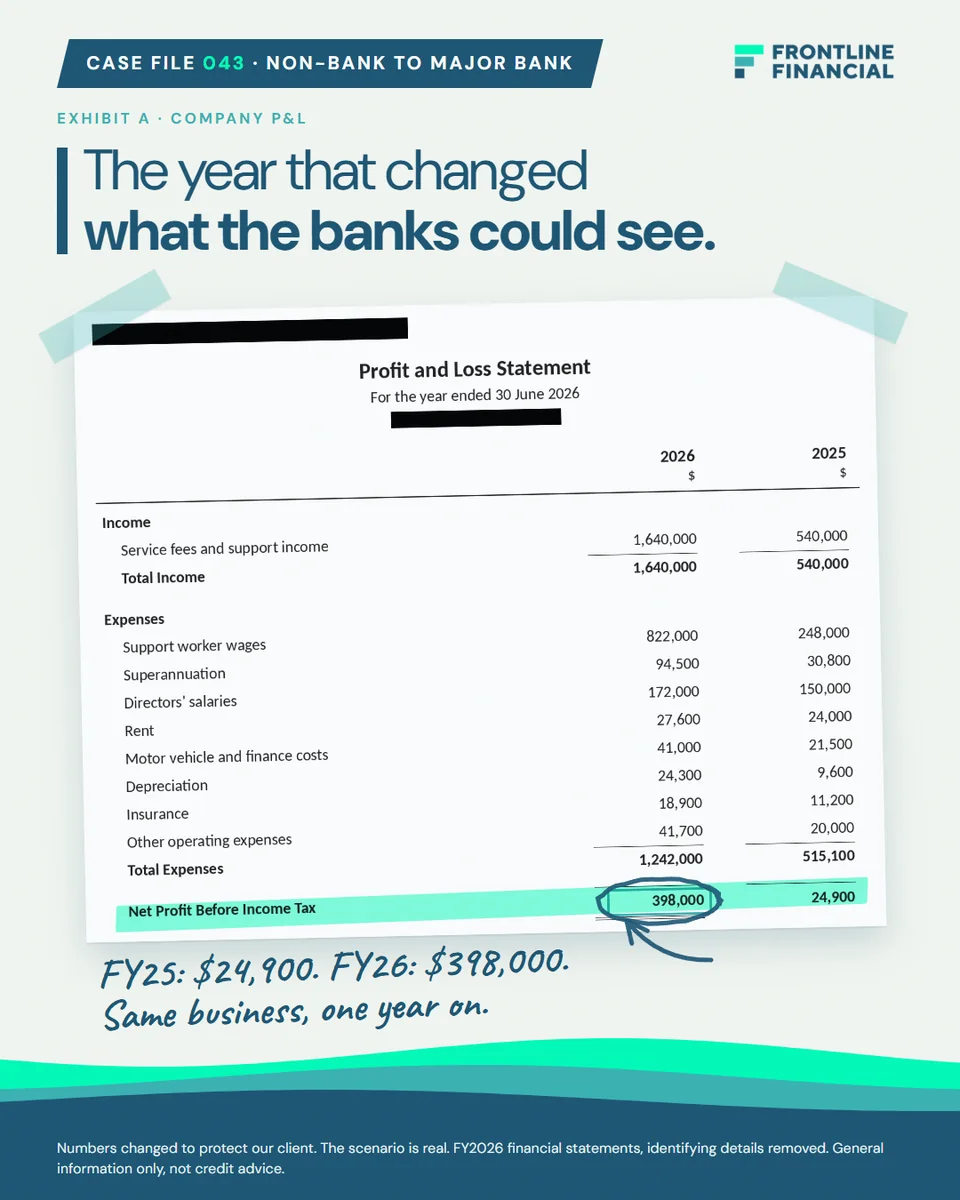
Early this year a couple came to us needing to refinance three investment properties. They run their own company together. That company made $24,900 in the year before. This year it was on track for close to $400,000.
The problem was that the big year hadn't closed yet, so no bank could see it. This is how we got a bank to count every dollar of it, and why we started with a non-bank loan on purpose.
Why the banks couldn't see the income
If you're self-employed, banks lend on your last tax return, not on what you're making today. This couple's last lodged return said $24,900. Their accountant couldn't finalise the big year until the financial year closed on 30 June.
So on paper they were still a $24,900 business, and on that income no bank could make three investment loans work.
Why we started with a non-bank lender
A non-bank lender will lend on your quarterly business activity statements and an accountant's letter, not your latest tax return. It costs more. The rate is higher, and it isn't where you want to stay.
So we used it on purpose, as a bridge. We told the clients on day one that this was temporary, and wrote the exit into the plan: the month their new tax return was lodged, we'd apply to a bank.
Getting the new tax return done early
Many businesses lodge the year's accounts the following autumn. That would have meant another six months on the higher rate, at roughly $600 a month in extra interest.
We worked with their accountant to finalise the company and personal returns in September instead. A bank wants the whole set: personal returns and notices of assessment, the company return, financial statements with the depreciation schedule, and a letter from the accountant confirming the returns were lodged. We had all of it ready on day one.
One more catch: most banks average two years
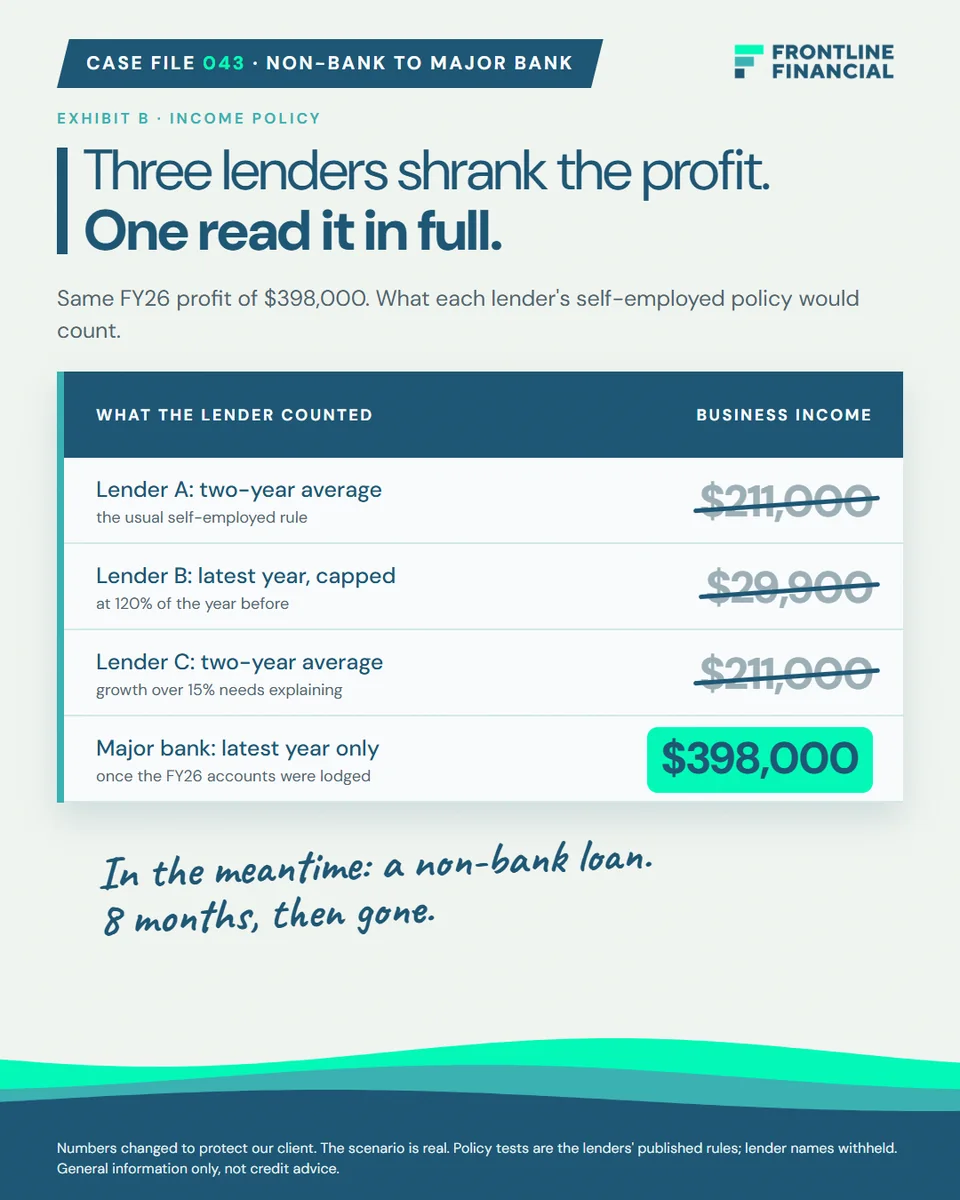
Even with the big year on paper, most banks average your last two years. For this couple that was $211,450, about half their real profit. Some lenders cap the latest year at 120% of the year before, which counted just $29,880.
What each lender rule would count
Last year $24,900, this year $398,000. Same couple, same returns.
We screened the banks' self-employed policies and found a major bank that assesses the most recent financial year on its own when that's the only year provided. Under that one rule, every dollar of the $398,000 counted. That's about $187,000 more assessable income than a two-year average.
The curveballs
Deals like this rarely go in a straight line. Three things needed fixing along the way.
- The broker lodgement system defaulted to a two-year average and showed the loans failing. We attached the bank's own calculator on the latest-year basis and explained the difference in the notes.
- The cash-out had two purposes: renovating the rented properties and a deposit for the next one. Lenders can treat those differently, so we split the money by purpose in the application. Your accountant is the person to ask about the tax side.
- One property's full valuation came in above the bank's automated estimate, which kept the loan within 80% of its value.
The result
Eight months after the non-bank loan, all three properties moved across to the major bank.
Moved to a major bank
3 loans, $2,560,000
Loan to value ratio
78% overall
Lenders mortgage insurance
None
Equity released
$330,000
Interest saving
About $7,000 a year
Time on the non-bank loan
About 8 months
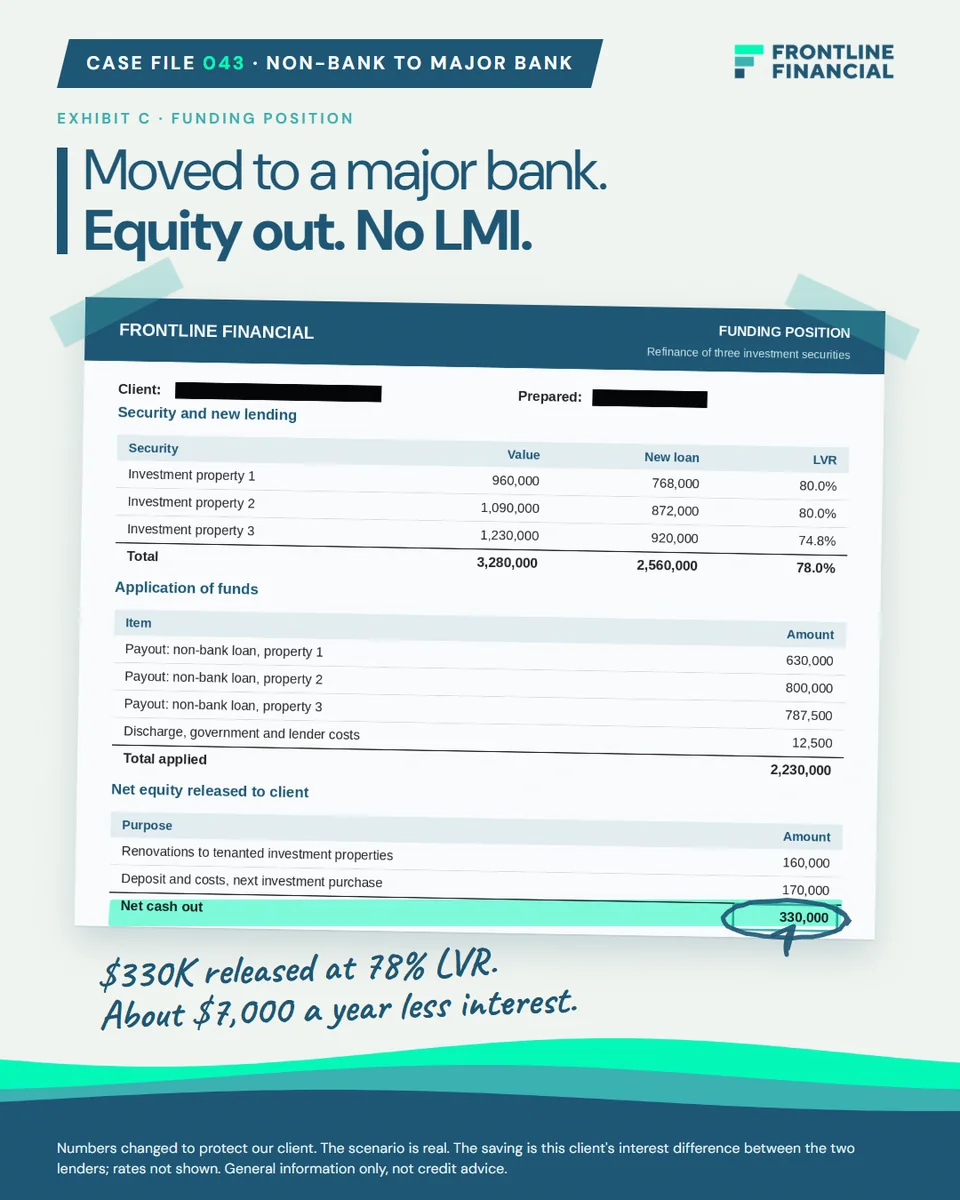
The non-bank loan did exactly the job it was there for. It held the properties together while the business grew, and then it was gone.
On a non-bank loan now? Ask these four questions
If you took a non-bank or low doc loan because your returns were behind your business, it's worth knowing when you could move, before your next accounts are done.
- 1When will my next tax returns be lodged?That month is usually the earliest you can move.
- 2Does my latest year show the real business?If it’s well up on the year before, which lender reads it matters a lot.
- 3Which lenders read that year on its own?Most average two years. A few don’t.
- 4What does it cost to leave?Exit or early repayment fees, discharge costs and government fees.
Lenders read self-employed income in very different ways. There's an example with add-backs in how lenders read your tax return, and more on full doc and low doc loans on our page about self-employed home loans.
Quick answers
Can I refinance from a non-bank lender to a bank?
Often, once your income can be shown the way a bank needs it, usually through lodged tax returns and financials. It depends on your income documents, the property, your loan size and each bank’s policy, so it’s worth checking before your next accounts are done.
Do all banks average two years of tax returns?
No. Most average your last two years, some cap your latest year at a percentage of the year before, and some will use the latest year on its own if it’s the only one you provide. That difference can change what you can borrow by a lot.
What is an alt doc or low doc loan?
A loan that uses other evidence of income, such as BAS, business bank statements or an accountant’s letter, instead of full tax returns. These loans usually cost more, and many borrowers refinance to a standard loan once their returns catch up.
Are there costs to leave a non-bank loan?
There can be. Some non-bank loans have early repayment or exit fees in the first years, and there are discharge and government fees on any refinance. Check your loan contract, and we’ll work the costs into the numbers before you decide.